
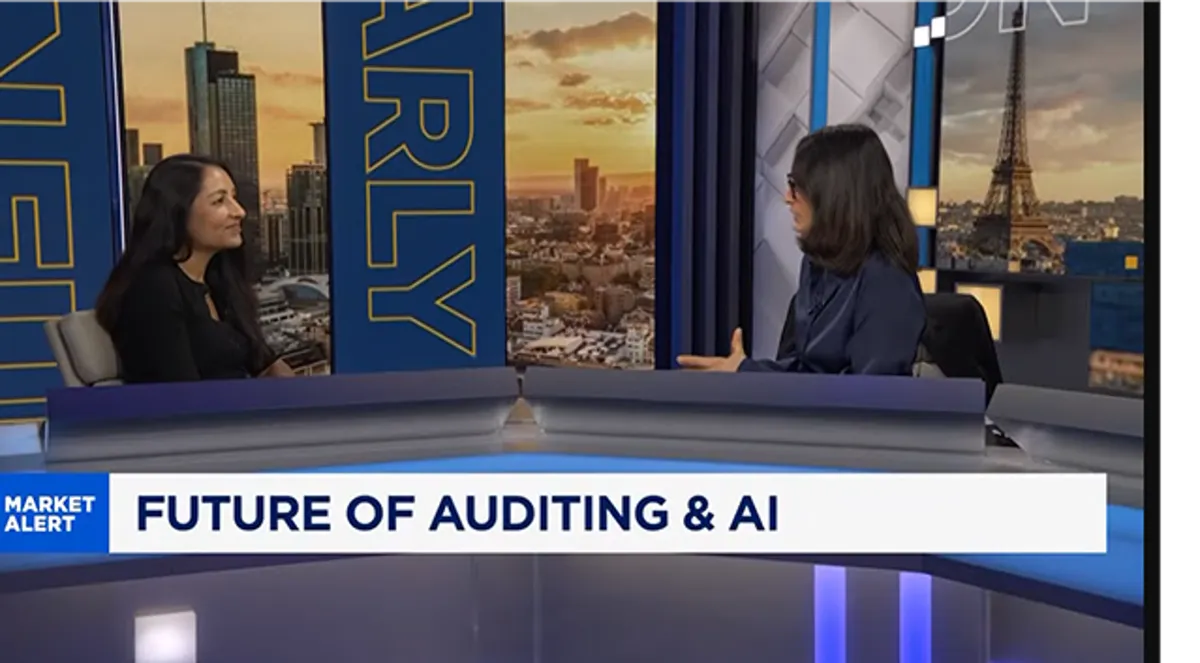
On August 20, 2026, DataSnipper CEO Vidya Peters appeared on CNBC Europe Early Edition to discuss the use of AI in auditing.
During the interview, she addressed several important issues, including trust, the talent shortage, and why AI adoption in auditing should not be treated as a race for speed.
Here are three key takeaways from the conversation.
1. AI in Auditing Is a Trust Problem, Not a Speed Problem
The conversation began with a simple question: How is DataSnipper using AI in auditing and data reconciliation?
Vidya Peters' response offered an entirely different perspective on the issue.
Speed Is Not the Most Important Factor
"It's not just about how quickly you can get the work done, but also about your ability to explain and defend the work you've done with AI. You can face regulatory penalties if you cannot account for every line in your audit workpapers."
This is an aspect that many AI solution providers tend to overlook.
Auditing is not an industry where faster execution automatically translates into a competitive advantage. On the contrary, it is a profession where errors can have serious consequences.
According to Peters, this reality has shaped DataSnipper's approach to developing its Agentic AI products from the outset, prioritizing traceability and process transparency rather than simply maximizing the volume of work completed.
Why Does AI Explainability Matter in Auditing?
"Today, many companies are using AI as a black box: you enter a prompt and get an answer. But the questions are: What did the AI do? What did the human do? And where was professional judgment applied?"
These are precisely the questions regulators will ask.
Peters explained that DataSnipper has built its platform to answer them.
Every number, down to the last decimal place, must be traceable to its original supporting evidence.
In auditing, this is not an optional feature designed to enhance the user experience. It is a fundamental requirement.
This is also what distinguishes purpose-built AI for auditing from general-purpose AI tools.
When a general-purpose AI assistant such as Claude or Copilot is asked to test a dataset, it may return a highly confident answer without providing an audit trail showing which documents were reviewed, which data rows were sampled, or where human professional judgment was applied.
Purpose-built AI for auditing, by contrast, operates differently.
Every step performed by an AI Agent is linked to source evidence within the spreadsheet, allowing the entire reasoning process to be traced, reviewed, and verified down to the individual row.
In a profession where the deliverable is not just a number, but also the ability to explain and defend its accuracy, explainability is more than a feature. It is a prerequisite.
Data Residency Is Non-Negotiable
Peters also emphasized an issue rarely discussed in conversations about AI products: Where is the data stored?
According to DataSnipper, it is the only audit platform capable of providing AI data residency across the United States, Europe, and the Asia-Pacific region.
For audit firms handling clients' financial data across borders, this is a significant consideration, not merely a minor detail in a marketing message.
2. 75% of Audit Leaders Support AI, but Only 13% of Workflows Actually Use It
The AI adoption figures Peters cited came from DataSnipper's own AI in Audit Report.
The numbers were so striking that the interviewer interrupted her mid-sentence.
The Gap Between Expectations and Reality Is Enormous
"75% of audit leaders are very supportive of using AI. However, only 13% of workflows actually integrate AI."
This is not a discrepancy caused by rounding. It is a structural problem.
Leadership enthusiasm for AI has yet to translate into meaningful changes in day-to-day workflows.
Peters also identified a specific barrier preventing this transformation.
The Barrier to AI Adoption: The "Blank Page Problem"
"They're struggling with what I call the 'blank page problem' — they want to use AI, but they don't know where to start."
Most audit teams understand that they should be doing something with AI.
They have attended product demonstrations, participated in solution presentations, and approved budgets.
But when it comes to implementation, they lack a clear starting point.
No concrete first step.
No ready-made workflow templates.
And no obvious entry point for putting AI into practice.
Pre-Built AI Agents: A Starting Point for AI Adoption in Auditing
DataSnipper's solution is to develop a library of pre-built AI Agents covering some of the most common audit and finance procedures, including:
Payroll testing.
Revenue testing.
Quarter-end closing processes.
The goal is not to fully automate these procedures, but to give audit teams a clear starting point.
Building on these ready-made workflow templates, DataSnipper customers have developed thousands of their own Agentic AI workflows.
3. AI Will Not Replace Auditors — It Is Helping Them Move into Higher-Level Roles
"I'm an optimist. I believe they'll be promoted. Instead of starting as an entry-level employee processing data, you'll start as an entry-level manager. But you won't be managing people; you'll be managing AI Agents."
Peters offered three reasons why auditing cannot be automated to the point where human involvement is no longer necessary.
First, auditing is a highly regulated profession.
No AI vendor will be called before the U.S. Securities and Exchange Commission (SEC) to take responsibility for and defend the results of an audit.
Second, auditing requires continuous professional judgment in complex and ambiguous situations.
Peters described this as "navigating an ocean of gray areas."
Third, auditors develop a deep understanding of their clients through ongoing working relationships.
That understanding provides the foundation for delivering high-quality inputs to AI in the first place.
The Audit Talent Crisis Predates AI
Peters challenged the view that AI poses a threat to employment levels in the audit profession.
She emphasized that the industry had already been experiencing a talent drain long before AI emerged.
"We're seeing fewer and fewer people entering the profession, while more and more people are leaving because of burnout. This was happening before AI. AI brings tremendous benefits because it enables a talent-constrained industry to do more with less."
This offers a particularly important reframing of the issue.
The question is not whether AI will shrink the audit workforce.
In reality, the profession has already been experiencing a declining workforce due to employee turnover, burnout, and falling enrollment in accounting programs.
AI is entering an industry already facing a talent supply shortage, rather than creating the problem itself.
Watch the full interview with Vidya Peters on CNBC Europe Early Edition.
EGP Vietnam
DataSnipper Consulting and Implementation Partner in Vietnam
Contact us to schedule a live demo:
Thai Nguyen
thai.nguyen@egp.vn
0912 500 085
Source: